
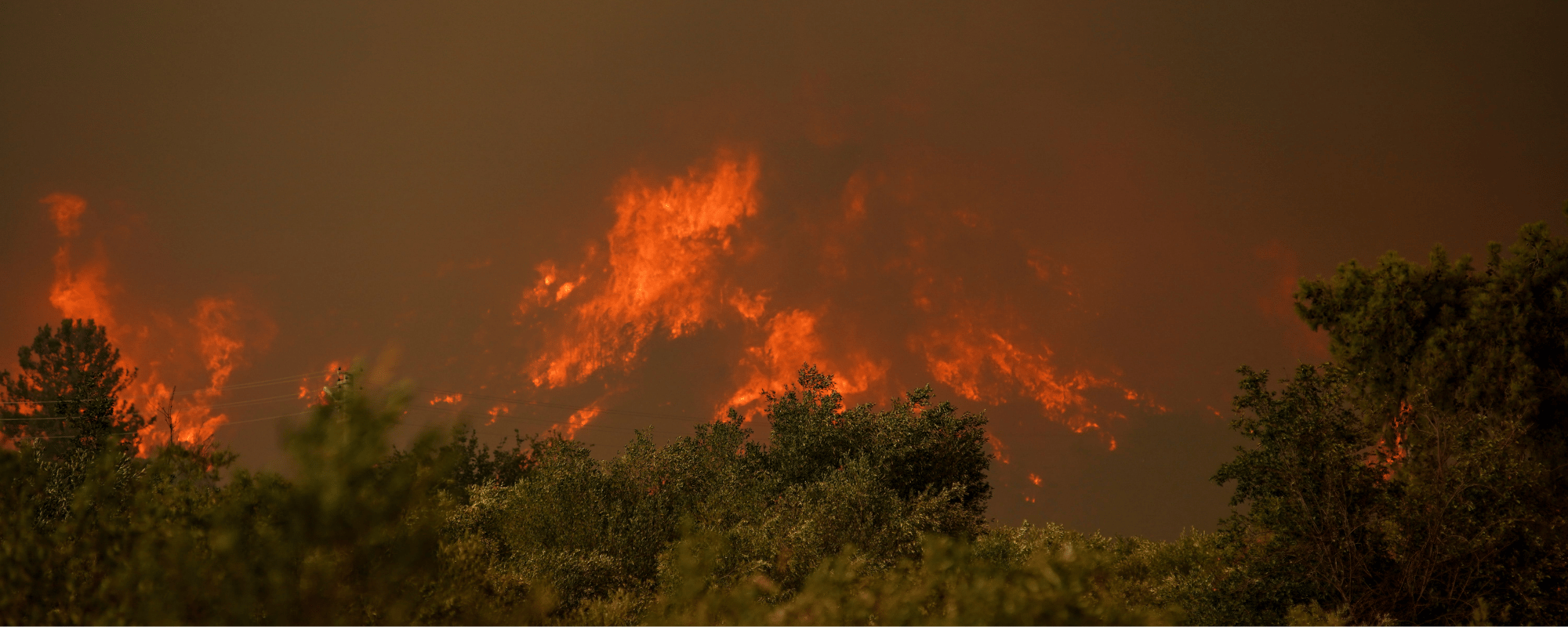
Right now, wildfires are burning simultaneously across the United Kingdom, France, Spain, Crete, Canada, the United States, Norway and North Africa. As former fire and emergency chiefs, we’ve spent our careers analysing unfolding disasters. Here’s what it’s telling us — and what Australia should be doing about it.
The following statement can be attributed to Emergency Leaders for Climate Action.
1. Places that never used to burn, now are.
Countries that have always burnt, like Australia, are burning more, and countries that historically hadn’t been considered fire-prone now are. Places where fire was never considered a major risk are now dealing with regular fire emergencies: in the boreal forests of Canada, in Norway, in Greenland, and with a “firewave” taking hold across the United Kingdom.
2. Traditional ‘fire seasons’ are a thing of the past, with the threat now starting earlier and lasting longer.
We knew when bad fire seasons were coming, and what to expect. But over the past 25 years there’s been an incredible escalation: Canberra in 2003, Black Saturday in 2009, our national Black Summer in 2019-2020. Internationally: the Los Angeles fires of January 2025 hit in the middle of winter — months outside California’s normal fire season. In Australia, our fire seasons have already grown by at least 27 days (a 20% increase) over the past 40 years (CSIRO 2022). The boundaries that once told us when to be on guard no longer hold.
3. Our ability to help each other is diminishing.
Simultaneous fire emergencies are breaking out across six countries and three continents. Spain has called for more firefighting aircraft, but there is nothing spare to send. Fire seasons used to be sequential — the northern hemisphere’s summer, then the southern — which meant countries could send firefighters, aircraft and equipment to help each other when it mattered most. That safety net is disappearing. The United States has already called for support from Australia and other countries. Europe has had to draw aircraft and crews from more than half a dozen countries just to fight the fires in France and Spain alone, and fires are starting to break out in other European countries. When everywhere is burning at once, no one is left to come to anyone’s aid.
4. Our fire agencies and warning systems are already being outpaced.
Pyroconvective (fire generated) storms used to be considered “black swan” events. Between 1978 and 2018, there were 60 recorded across Australia. During Australia’s Black Summer, a Royal Commission heard that there was a “flock of these Black Swan events” recorded (25, later revised up to 45) (Abrams et al, 2020; Binskin et al, 2020; Sharples in UNSW 2025). In Canada’s horror 2023 fire season, when 15 million hectares burned, 142 of these formerly rare events were recorded (Khaykin et al. 2025). France just recorded its first (Bowman, Williamson and Cunningham, 2026). Fire-generated storms create fires that can’t be fought, and are a clear signal of the worsening fire weather driven by climate change.
After Black Saturday in 2009, Australia had to introduce a new category of fire danger — Catastrophic — because the previous scale that topped out at 100 couldn’t describe the increasingly common fire weather conditions that far exceeded this threshold. We are seeing the same pattern globally: existing thresholds, warning systems and preparedness levels are being exceeded, not once, but repeatedly, across multiple countries in the same fortnight.
The frequency and severity of today’s wildfires is unprecedented and worsening. Make no mistake: this is driven by climate pollution from the burning of coal, oil and gas, making the world hotter and drier, fuelling more severe and frequent fire weather.
5. More of us are living exactly where bush and fire meet.
Across Europe, North America and Australia millions of people live in areas described as the ‘urban-bushland interface’, where suburbs meet the bush. Because of their proximity to the bush, many households in these interface areas face significant fire risks. A recent study has shown that the vast majority of people impacted by wildfires (defined as living within 1km of a fire) resided in interface areas. In the US, 86% of people impacted by wildfire between 2000 and 2023 lived in suburbs neighbouring bushland. The same is true for Canada (74%), the United Kingdom (88%), Spain (86%), France (88%), Greece (81%) and Australia (88%), among others (Schug et al. 2023).
Globally, 10% of fires cause 78% of all fatalities, and almost all of those happen at the interface (Synolakis and Karagiannis 2024). This is the threat that many in Europe have faced this year, with wildfires close to Madrid in Spain and Bordeaux in France.
6. Wild swings in weather robs us of a key mitigation tool – hazard reduction burning
The Black Summer bushfires were extinguished by intense rainfall, and people then suffered through three years of record floods. This has become a pattern worldwide referred to as “climate whiplash”; wild swings from drought, heatwaves and fires to storms and flooding rains. These rains make the situation worse in two main ways: they lead to prolific growth of grass and scrub that fires love to feed on, and they prevent fire and land management agencies from carrying out hazard reduction burning because vegetation is too wet to ignite. Last century, agencies had longer windows of mild weather each year when they could burn. Now, these windows are shrinking – rapidly swinging from too wet to burn, to conditions that are too dangerous (hot, dry and windy) to maintain control.
This isn’t just a bad year. It’s our new reality.
The National Climate Risk Assessment modelling showed that at 3°C of global warming, the area of Australia facing catastrophic fire danger triples — from 270,000 km² to 810,000 km² — with temperatures reaching 48°C in Victoria, NSW and South Australia (ACS 2025). During Black Summer parts of Sydney reached 49°C (Melville-Rea 2022). In the European Union, the number of people living near bushland and exposed to high-to-extreme fire danger levels for at least 10 days per year would grow by 15 million (Euronews 2026).
As former fire and emergency chiefs, we have watched fire behaviour change markedly during our careers. Fires now spread faster and burn more intensely, sometimes creating their own weather systems and burning intensely overnight. On the worst days, some become impossible to fight and firefighters must fall back to their highest priority: saving lives, as the only thing they can do. This is the new reality firefighters and communities face worldwide.
We still control exactly how bad this situation gets, but only if climate pollution is cut more deeply, and swiftly until we reach net zero.
In Australia, we should be on high alert for what’s to come. The strongest El Niño ever recorded arriving on top of climate change is a very dangerous combination. It could signal drier, hotter conditions like those fuelling the northern hemisphere’s fires, not just this summer but also in 2027/2028.
Governments cannot keep approving new coal, oil and gas projects as this adds fuel to this crisis, at home and abroad. The politicisation of climate change is unbelievable to those of us who are laser focused on public safety and know the ultimate cost of denying we are in a climate crisis.
Firefighters will continue to do everything they possibly can to protect life, property and the environment from bushfires intensified by climate change, and as we’ve seen, some will pay the ultimate sacrifice – a price that we say is far too much. Governments must do their bit: stop approving and expanding coal, oil and gas projects and rapidly cut climate pollution.
References
Australian Climate Service 2025 Australia’s Future Climate and Hazards Report. Accessed 31 July 2026. Accessed: https://www.acs.gov.au/pages/ncra-reports
CSIRO 2022 Extreme fire weather days in Australia have increased, accessed: https://www.csiro.au/en/news/all/ news/2022/july/extreme-fire-weather-days-in-australia
Euronews 2026 Behind Europe’s mega fires: Would France and Spain still be ablaze if it weren’t for climate change? Accessed: https://www.euronews.com/2026/07/31/behind-europes-mega-fires-would-france-and-spain-still-be-ablaze-if-it-werent-for-climate-
Melville-Rea, H 2022 Western Sydney will swelter through 46 days per year over 35°C by 2090, unless emissions drop significantly. The Conversation, 17 February. Accessed 31 July 2026. Accessed: https://theconversation.com/western-sydney-will-swelter-through-46-days-per-year-over-35-c-by-2090-unless-emissions-drop-significantly-177056
Schug, F et al 2023 The global wildland–urban interface. Nature, 621, 94–99. Accessed 31 July 2026t: https://www.nature.com/articles/s41586-023-06320-0
Synolakis C, Karagiannis M 2024 Wildfire risk management in the era of climate change. PNAS Nexus, 3(5). Accessed 31 July 2026: https://doi.org/10.1093/pnasnexus/pgae151
